
The Quiet Difference Between Software That Exists and Software That Works
- Finance
- Dec 22, 2025
- By Muhammed Saleem
The project started with excitement.
The idea was solid. The roadmap looked right. The team moved fast.
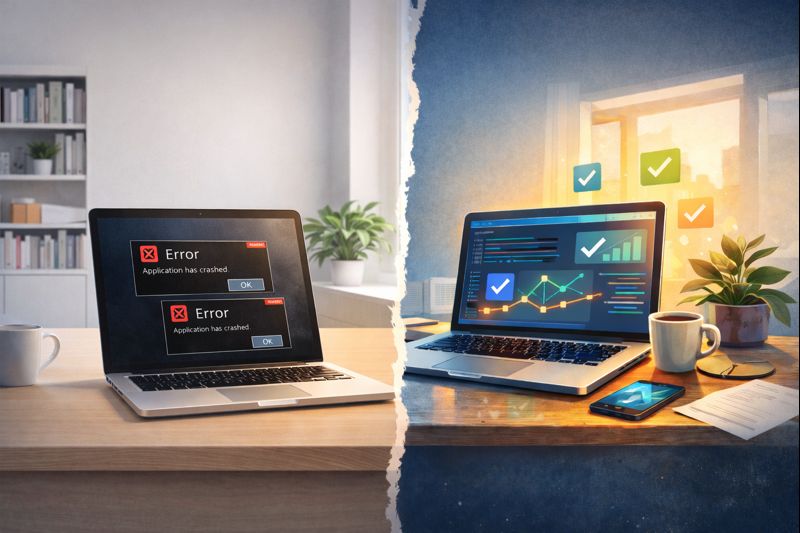
Six months later, the application was live. Within weeks, friction appeared. Users struggled to adopt it. Performance dipped as usage increased. Security reviews raised questions that were hard to answer quickly. Every small change took more time than expected. Budgets stretched. Timelines slipped. Nothing had failed outright. But the application was no longer helping the business move forward.
What most organizations are really asking for
Most organizations are not chasing flashy software. They want Product Engineering that scale without breaking, stay secure without slowing teams down, and feel intuitive in daily use. They also want development cycles that respect budgets and timelines.
What they are really asking for is confidence. Confidence that the system will hold up as the business grows. Confidence that changes will not create new risks. Confidence that technology will support decisions, not complicate them.
Where many builds go off track
Problems usually do not start with bad execution. They start with misalignment.
Applications are built without fully understanding real workflows. Scalability is assumed instead of engineered. Security is addressed late. Features grow faster than structure. Over time, complexity increases and flexibility disappears.
The application still works. But it works against the business instead of with it.
A different way to think about building
There is another way to approach Product Engineering.
It starts with understanding how the business actually operates. Applications are designed to fit naturally into existing systems. Scalability is part of the foundation.
Security is treated as a baseline expectation. Development happens in controlled, transparent cycles that teams can plan around.This approach does not aim to impress at launch. It aims to stay reliable long after launch.
When software becomes an enabler
When applications are built this way, the impact shows up quietly.
- Teams adopt the system instead of working around it.
- Growth feels supported instead of stressful.
- Updates become predictable.
- Costs stay under control.
- Decisions get faster and clearer.
The software stops demanding attention and starts doing its job.
Why this matters now
As organizations grow, technology becomes inseparable from operations. If applications cannot scale, growth slows. If systems feel fragile, teams hesitate. If timelines and budgets keep slipping, trust erodes.
Building software that truly works is no longer optional. It is foundational to sustainable growth.
Building for the long run
This is the mindset Analystor brings to product engineering. We design and build applications that align with business goals, integrate naturally into existing ecosystems, and evolve as the organization grows.
Not software built for a moment.
Software built for continuity.
Ready to build software that grows with you?
If your current applications feel harder to manage as your business scales, it may be time to rethink how they are built. Let us have a focused conversation about what you are building, where it needs to go, and how to get there without surprises.
Talk to us about Product Engineering that lasts.

- January 21, 2025
Accelerate Your Journey to ROI with Low-Code Development

- November 26, 2024
Microservices Architecture: An alternative to monoliths
- August 02, 2024
Agile vs DevOps: A Detailed Comparison

- June 22, 2024
Enhancing Efficiency of Big Data Projects with Talend

- July 01, 2024